PRATER WAY REHABILITATION
Project Overview
| Label | Value |
|---|---|
| Status | Active Projects |
| Project Details | 222031 |
| RTC Project Manager (PM) | Kimberly Diegle, P.E. |
| RTC Engineering Department | (775) 335-1844 |
| Design Firm | Lumos & Associates |
| Construction Contractor | Sierra Nevada Construction, Inc. |
Project Description
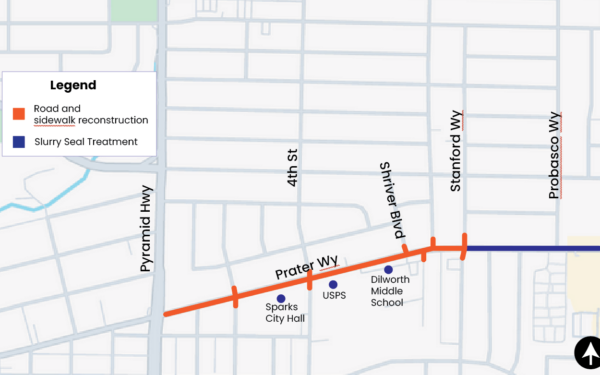
This project is part of RTC’s Pavement Preservation Program and will rehabilitate pavement on Prater Way from the east side of Pyramid Way to Stanford Way, with additional improvements east to Probasco Way. Improvements include:
Pyramid Way to Stanford Way Segment:
- Roadway pavement reconstruction.
- Drainage improvements including curb & gutter replacement.
- Pedestrian ADA upgrades including sidewalk and driveway replacement – widening to 5 ft minimum.
- Utility manhole adjustments.
- Raised pedestrian refuge island at Shriver/Dilworth MS crosswalk.
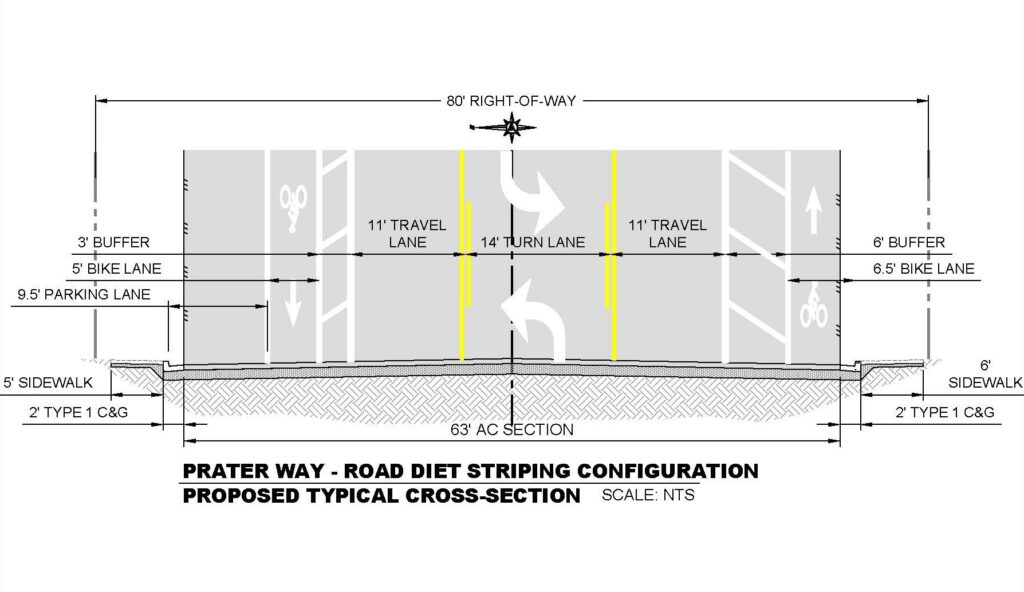
- New striping (see Proposed Road Diet).
Stanford Way to Probasco Way Segment:
- Slurry seal treatment.
- New rectangular rapid flashing beacon at Stanford relocated crosswalk.
- New striping (see Proposed Road Diet).
Proposed Road Diet:
RTC is proposing a striped Road Diet concept from Seventh Street to Probasco Way (approximately 1/2 mile) which includes one travel lane in each direction, a center turn lane, buffered bicycle lands and on-street parking on the north side of the street.
Latest News
Sierra Nevada Construction began work on June 8, 2026 and is scheduled to be complete in November 2026. The Road Diet configuration will be implemented with this project.
Project Virtual Presentation:
PROPOSED ROAD DIET
FREQUENTLY ASKED QUESTIONS
What is a road diet?
A road diet reconfigures an existing roadway—typically by reducing the number of general-purpose travel lanes—to improve safety and operations for everyone using the street. On Prater Way, the road diet is achieved through striping changes, not roadway widening.
________________________________________
What is being proposed for Prater Way?
The proposed road diet converts Prater Way to:
• One travel lane in each direction
• A center two-way left-turn lane
• Buffered bicycle lanes
• On-street residential parking retained on the north side
Prater Way will remain two lanes in each direction near Pyramid Way and transition to the road diet between 7th Street and 6th Street.
________________________________________
Why is a road diet being proposed here?
This segment of Prater Way has a history of serious crashes and is part of the region’s High Injury Network. From 2019–2023, over 100 crashes occurred, including injury and fatal crashes. The existing wide, five-lane configuration encourages speeding and creates conflicts between vehicles, pedestrians, cyclists, and parked cars.
________________________________________
How does a road diet improve safety?
Road diets are a proven safety strategy. On Prater Way, the proposed design:
• Reduces vehicle speeds
• Lowers the number of conflict points
• Decreases sideswipe crashes with parked cars
• Improves visibility and access at driveways
• Shortens pedestrian crossing distances
• Creates safer space for people biking and walking
• Improves access and operations at bus stops
The Project safety analysis estimates a 34% or greater reduction in crashes.
________________________________________
How will this affect traffic and travel time?
Traffic analysis shows vehicle queuing and congestion will increase with the road diet. Travel time through the corridor is expected to increase by about 35 seconds (roughly 15% during peak hours). While some side-street delays may increase, intersections will continue to meet acceptable performance standards. Signal timing adjustments can help manage congestion.
________________________________________
Why make this change now?
Prater Way already needs major pavement work. This project allows RTC to:
• Fix failing pavement
• Improve safety at the same time
• Avoid more expensive reconstruction later
• Implement a proven traffic management approach with flexibility
________________________________________
What happens if traffic gets worse in the future?
The road diet is installed using striping, not concrete or curb changes. That means:
• Lane configurations can be adjusted
• Signal timing can be modified
• The corridor can revert to five lanes if long-term conditions require it
This approach allows RTC to respond to real-world performance after implementation.
________________________________________
Why not keep all five lanes?
Alternatives that kept five lanes were studied but offered fewer safety benefits, removed residential parking, or significantly increased costs. The striped road diet provides the best balance of safety, cost, parking retention, and adaptability.
________________________________________
When would the road diet be implemented?
The road diet would be installed as part of construction, currently planned for Spring 2026 through late Fall 2026, subject to change
Prater Way Rehab Public Comments
Schedule
Planning: N/A
Environmental: N/A
Preliminary Design: Fall 2024 – Summer 2025
Final Design: Summer 2025 – Winter 2025-2026
Construction: Spring 2026 – Fall 2026
Financial Information
Total Project Estimate: $9,031,000
Funding Source: RTC Fuel Tax
To bid, click here: https://rtcwashoe.procureware.com/login
